
Household consumption data based on non-cash payment records

Denna artikel är en del av vår artikelserie om datakällor som du hittar under huvudmenyn byggstenar; samt en del av artikelserien om Projekt Reflow. Vi kommer allt eftersom att fylla på med fler artiklar. Har du fler idéer på liknande artiklar kontakta oss på kontakt@digivis.se
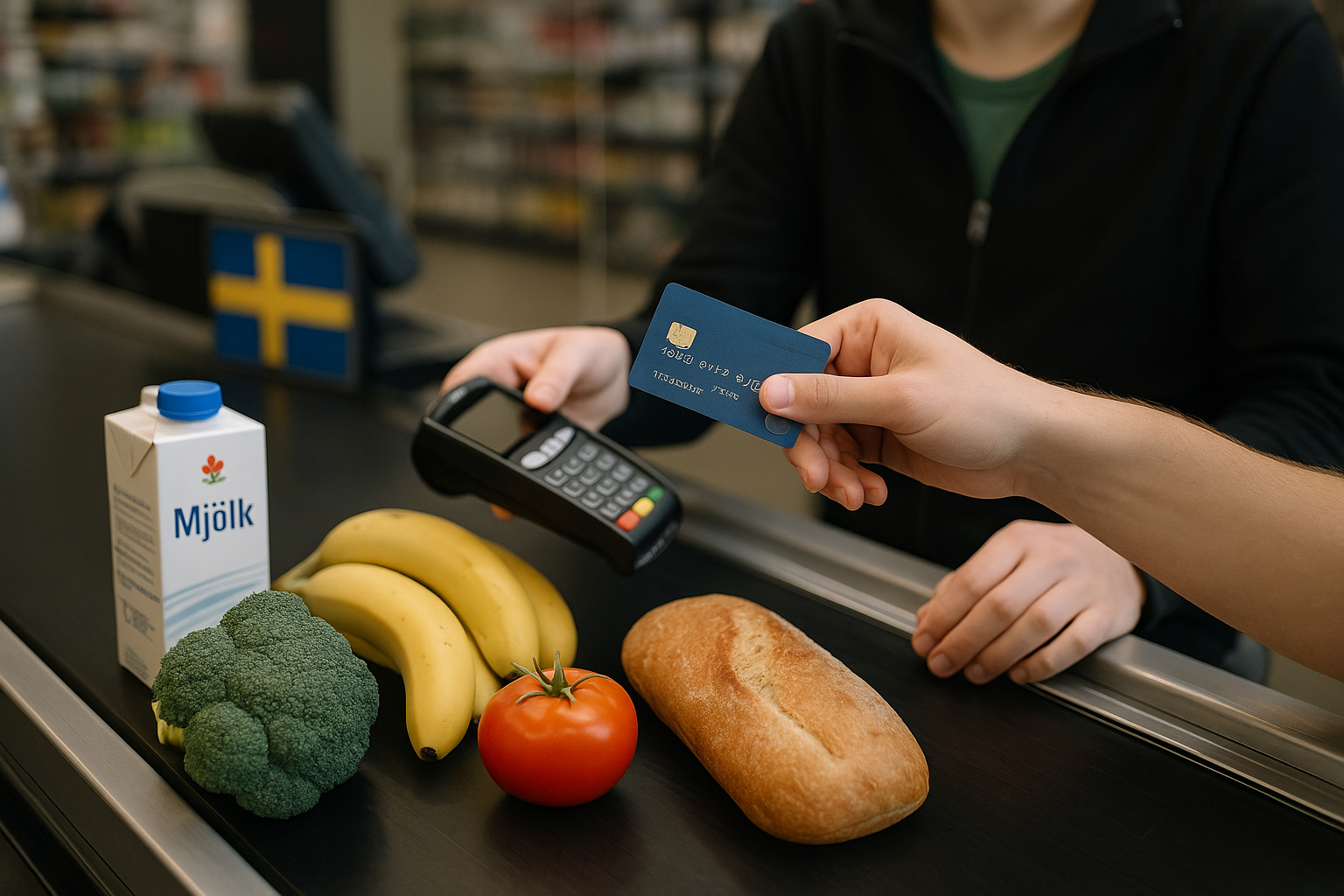
The advent of non-cash Swedish society opens the door to capture the payment records of household consumption, i.e. direct data is available on household purchasing based on non-cash payment records for various goods and services households paid for.
Background
According to SCB (for year 2023) card transaction data on daily household consumption captures ~ 50% of total Swedish household expenditures. The rest of the household expenses are invoice purchases (fakturaköp) corresponding to about 40-45% household spending, mainly for housing (but not including purchasing for maintenance & repairs through card payment) and personal vehicles, including housing rent, housing energy (electricity & heating) and new/used cars. Meanwhile, cash transactions are at around 5% and have been declining.
Card transaction data from card issuers
Ideally, data directly from card issuers (Master/Visa/AE cards issued by banks like Swedbank, SEB, or other merchants e.g. supermarket and gas-station trains) are desired, as the data are linked directly to individual consumption payments, allowing tracking of personal consumptions (e.g. a person living in Stockholm buying a pair of shoes in Italy) and consumption patterns linked to card holder’s demographic info (age, region, possibly income bracket). However, practical disadvantages are also apparent in that:
- Difficult to access: very sensitive data concerning privacy and legal restrictions;
- Incompleteness: one issuer has only one data set of its customers, while there are tens of issuers, which making the collection of complete card transaction data practically a huge task requiring dedicated efforts (perhaps only possible by e.g. SCB that has both the resources and authority?). Indeed, SCB also collects card transaction data from (major) credit card issuers (banks) in Sweden, capturing ~ 71% of total credit card transactions in value for year 2023[1]. This is 16% lower than the data collected on the card acquirer’s side, which is attributed (mainly) to that “SCB saknar transaktionsdata från de stora detaljhandelskedjorna som ger ut egna kort”.
Card transaction data from card acquirers (e.g., Nets, Swedbank Pay, Bambora)
Contrary to data from card issuers, the main advantages of data from card acquirers are the data completeness and practically much more easier to collect, as there are just a few main acquirer players that track where and on what money is spent (retail category, sector, region):
- SCB has since 2021 collected data from card acquirers. For year 2023, the collected data corresponds to ~87% of total credit card transactions in value in Sweden;
- NETs (Nexi Group) also offers aggregated transaction data reporting of its customers. This data tracks where money is spent at the aggregate level, but limited for understanding who is spending, as it lacks direct linkage to individuals and demographic context.
That is to say, the main disadvantages of data from card acquirers are the lack of link to specific consumers linking e.g. the residence geo-region of the card holder. Hence, the data doesn’t capture household consumption purchases outside the data-collection boundaries of a targeted geo-region, e.g. Stockholm Stad, and may exclude online transactions as well.
Even so, it should be noted that even if data from card acquirers miss household spendings outside the data collection geo-boundaries, the data nonetheless also capture purchases made by cardholders living outside the targeted geo-area, which may suggest this data set (somewhat) might be treated as a proxy to the spendings of households living inside the targeted region.
Efforts taken to try to get some (sample) data for Stockholm/ Royal seaport area
In communications with SCB, we received a sample data from SCB on card transaction data within Stockholm Stad for the whole year 2024, collected from card acquirers:
- The data covers the sales that have occurred within postal code areas in Stockholm Stad that have been paid using (only) private credit cards, as well as total sales data paid by both private and company credit cards. The sales data is categorized according to SNI, into a total of 116 (SNI) 5-digit categories;
- As noted above, the sample data may serve as a proxy to household consumptions in Stockholm Stad 2024, in that the data does not reflect the exact purchases of Stockholmers (i.e. if a person living in Stockholm shops outside the region, that is not captured, and vice versa);
- Details on the consumption categories and total & average amount of purchases etc. see the corresponding Excel file sheet (to be linked).
Online shopping and Klarna & Swish
The widely cited figure is that 80–85 % of purchasing value based retail sales in Sweden still take place in physical stores, and online shopping corresponding to ~15% value-based retail sales [2][3][4], and this 15% market share is expected to largely remain the same in the near future, in Sweden.
From Riksbank’s 2023 payments survey [5]:
- Card payments are the most common online method;
- Swish comes second:
- BNPL (like Klarna) usage has decreased by about 15 percent since 2022, but according to Nordic market analysis (Tembi) [6] Klarna’s open invoice payment method (i.e., buy-now-pay-later BNPL) now (2025) account for over half of Sweden’s e‑commerce transactions by value.
So, apparently, apart from traditional card payment transactions in physical shops, online shopping payment data should also be considered. For this part, apart from card payments, Klarnas’ (dominant) BNPL transaction data, as well as Swish payment data, should also be, ideally, included.
Note: Klarna does not openly sell its aggregated consumer transaction data to external parties.
Note: it is unclear if SCB’s sample data also includes any Klarna or Swish data, most likely not…
In summary
Since cash payment becomes more and more less in Sweden (less than ~5%), it becomes possible to capture the vast majority of household consumption purchases by non-cash purchasing payment records of traditional credit card (MC/VISA/AE) as well as other digital payment methods like Swish, Klarna etc. Ideally, to capture household consumption in a geo-area, e.g. Stockholm Stad / Royal Seaport area, household purchasing payment data should be collected from credit card issuers and other digital payment service providers (e.g. Klarna etc. ), and financial firms that handle invoice payments, so that the (aggregated) purchase records can reflect consumption purchases of households within Stockholm or Royal Seaport, no matter if the purchases are within Stockholm boundaries or outside them (e.g. a purchase payment in Italy by a person living in Stockholm). However, due to privacy concern and legal restrictions, together with the large number of credit card issuers and other digital service providers and financial firms, this ideal data set seems very difficult to collect, if not (practically) impossible. Even so, indeed, SCB also collects transaction data from (major) credit card issuers (banks) in Sweden[8], corresponding to e.g. ~ 71% of total credit card transactions in value for year 2023. This is 16% percent lower than the data collected on the card acquirer’s side, attributed to that “SCB saknar transaktionsdata från de stora detaljhandelskedjorna som ger ut egna kort”.
On the other hand, practically feasible proxy data sets can and have been obtained, i.e., credit card purchasing data collected through players of the so-called card acquirers (that handle card payments on behalf of e.g., a shop or website). Since there are just a few (4-5) card acquirers (e.g. Nets etc.) serving thousands of shops or websites, it’s relatively easy to collect the aggregated purchase data which can not be traced back to sensitive card holder information. On this track, Nets/Nexi Group has already geo-aggregated data package for sale based on its own data, while SCB has much more complete data sets by collecting data from all the major card acquirers in Sweden covering over 90% of the corresponding total payments in Sweden, according to SCB[9]. As mentioned before, we got a sample data for year 2024 from SCB for the whole Stockholm Stad. Nevertheless, this data is yet at most the proxy data to the household purchases in a specific geo-area like Stockholm, as it just covers purchases taken place within that area, no matter if the purchases are carried out by households in that area (more likely though, especially for daily consumables etc.) or not.
Last but not least, Swish and Klarna play already significant roles in Sweden, especially in regarding online shopping payment service. A complete household consumption purchasing payment data set should include payment data from them, as well.
Vill du veta mer eller bidra till utvecklingen?
Den här artikeln är en del av DigiVis artikelserie om datakällor för Reflow. Har du erfarenheter, pågående initiativ eller idéer kopplat till det du läst – hör gärna av dig och bidra till den fortsatta utvecklingen.
Här kan du läsa mer om Reflow-projektet och den utveckling som pågår i Stockholms stad kopplat till resursflödesmodeller https://digivis.se/reflow
Nedan referenser och användbara länkar.
[1] https://www.scb.se/hitta-statistik/temaomraden/sveriges-ekonomi/fordjupningsartiklar_Sveriges_ekonomi/nya-mojligheter-att-fanga-konsumtionen-med-kortdata/?menu=open&utm_source=chatgpt.com
[2] https://www.statista.com/topics/9180/e-commerce-in-sweden/?utm_source=chatgpt.com
[3] https://www.mordorintelligence.com/industry-reports/sweden-ecommerce-market?utm_source=chatgpt.com
[4] https://goni.to/en/cross-border-e-commerce-expansion-sweden/?utm_source=chatgpt.com
[5] https://www.riksbank.se/en-gb/payments--cash/payments-in-sweden/payments-report--2024/trends-in-the-payments-market/payment-habits-in-sweden/swish-on-the-rise-in-e-commerce/?utm_source=chatgpt.com
[6] https://www.tembi.io/blog/payment-providers-in-european-e-commerce-a-country-by-country-analysis?utm_source=chatgpt.com
[7] https://start.stockholm/globalassets/start/om-stockholms-stad/utredningar-statistik-och-fakta/statistik/bostader/hyror/hyror_2024.pdf
[8] https://www.scb.se/hitta-statistik/temaomraden/sveriges-ekonomi/fordjupningsartiklar_Sveriges_ekonomi/nya-mojligheter-att-fanga-konsumtionen-med-kortdata/?menu=open&utm_source=chatgpt.com
[9] https://www.scb.se/hitta-statistik/temaomraden/sveriges-ekonomi/fordjupningsartiklar_Sveriges_ekonomi/snabbare-statistik-over-hushallens-konsumtion/?utm_source=chatgpt.com