
Household consumption data on drinking water - used in the Reflow prototype

Denna artikel är en del av våran artikelserie om datakällor som du hittar under huvudmenyn byggstenar; samt en del av artikelserien om Projektet Reflow. Vi kommer allt eftersom att fylla på med fler artiklar. Har du fler idéer på liknande artiklar kontakta oss på kontakt@digivis.se
Households consume a broad range of material resources. These material inputs can be grouped into categories such as food items, potable water, vehicles, along with their associated fuel use, fuels for domestic energy needs (like heating and cooking), and various other manufactured goods—both durable and disposable.
The annual volume of drinking water supplied for consumption in Stockholm was estimated based on national average data and allocation assumptions. A detailed breakdown of household water use by purpose, such as personal hygiene, toilet flushing, dishwashing, laundry, and food and drink, was derived from national per capita averages published by Svenskt Vatten. These usage proportions were then proportionally applied to both household and service sector consumption.
Data source
The data source of the volume of drinking water consumption is the national average data published in Svenskt Vatten (2022) report - Analys – Hushållens vattenkonsumtion.
 Analys – Hushållens vattenkonsumtion
According to this data source, in Sweden, an average of 140 litres of water is used per person per day. The 140 litres represent direct water use and include 60 litres for personal hygiene, 30 litres for toilet flushing, 15 litres for dishwashing, 15 litres for laundry, 10 litres for food and drink, and 10 litres for other uses, as illustrated in the figure below.
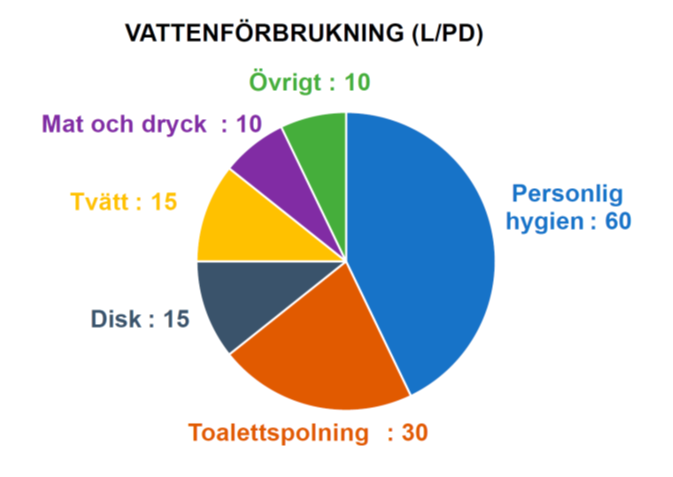
Adaptation of national data for household water-consumption in Stockholm
According to Sweden’s input–output tables, it is assumed that 90% of the distributed water is consumed by households and 10% by the service-providing service sector. Furthermorea detailed breakdown of household water use by purpose, such as personal hygiene, toilet flushing, dishwashing, laundry, and food and drink was assumed also following the same pattern as derived from national per capita averages published by Svenskt Vatten.
Based on these assumption, the total drinking water consumption in Stockholm for the year 2023 was estimated.
Vill du bidra till utvecklingen?
Den här artikeln är en del av DigiVis artikelserie om datakällor för Reflow. Har du erfarenheter, pågående initiativ eller idéer kopplat till det du läst – hör gärna av dig och bidra till den fortsatta utvecklingen.
Här kan du läsa mer om Reflow-projektet och den utveckling som pågår i Stockholms stad kopplat till resursflödesmodeller https://digivis.se/reflow